bhumi king italy - A premium brand by Shree Thakur Agri Industries, engineered in the steel hub of Punjab

Choosing the Right Rotavator Blade: L-Type, C-Type, or J-Type?
Rotavator blade information
Gurpreet Dhiman
2/3/20264 min read
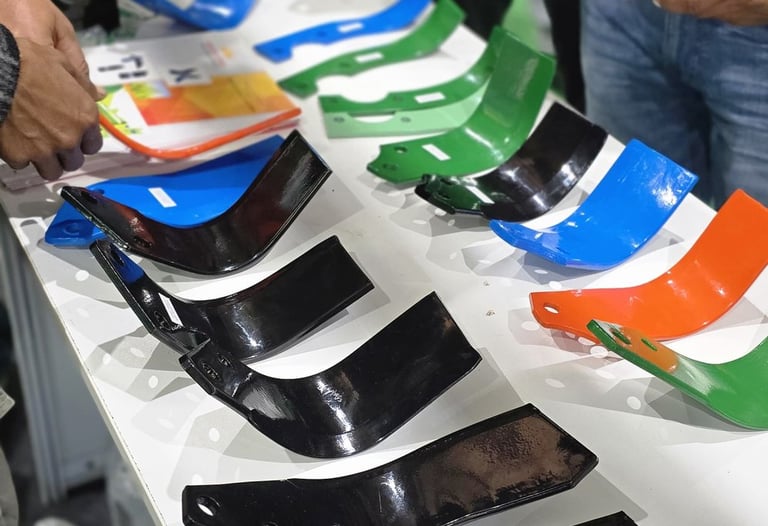
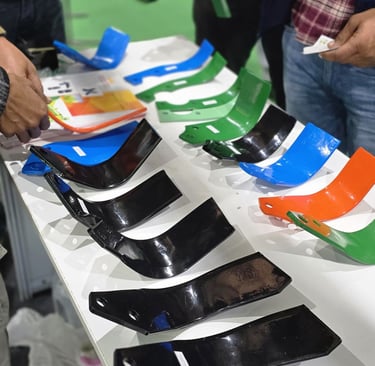
Understanding Rotavator Blades
Rotavator blades are essential components of the rotavator, a vital piece of equipment in modern agriculture designed for soil cultivation. These blades break up and aerate the soil, improving its structure and preparing it for planting. Efficient cultivation is crucial as it enhances seed germination rates, increases yields, and facilitates better water and nutrient absorption. As farmers and gardeners strive for optimal productivity, the role of rotavator blades becomes increasingly important.
Different types of rotavator blades are available, each designed to cater to specific soil conditions and farming practices. The three primary types are L-type, C-type, and J-type blades, each with distinct characteristics that affect their performance during soil preparation. Choosing the right blade type is critical for maximizing the rotavator's efficiency and ensuring that the soil is tilled appropriately.
L-type blades are characterized by their long, straight design, which provides excellent penetration and effective mixing of soil layers. This design is particularly beneficial for working in compacted or heavy soils, making it suitable for various types of farming applications.
C-type blades, on the other hand, feature a curved shape that enhances their ability to lift and aerate the soil. This aerodynamic design is especially efficient in sandy and loamy soils, allowing for smoother operation and reducing the effort required to achieve a fine tilth.
Lastly, J-type blades combine features from both L-type and C-type blades, providing versatility for different soil types. Their design allows for effective breaking of soil crust, making them ideal for varying cultivation scenarios.
Understanding the differences in rotavator blade types is essential for farmers when selecting the right blade to meet their specific soil management needs.
L-Type Rotavator Blades
L-type rotavator blades are designed specifically to tackle the challenges posed by dry and medium soil conditions. These blades are characterized by their unique shape, which provides optimal dilating and mixing of the soil, making them highly effective for achieving excellent soil pulverization. Their versatility makes them a popular choice among farmers and agricultural practitioners across India, where these soil types are prevalent.
One of the significant advantages of L-type rotavator blades is their efficiency in terms of power consumption. Because of their design, they require lower horsepower to operate, translating to reduced fuel costs and less wear and tear on machinery. This efficiency makes them a cost-effective solution for farmers looking to optimize their operations while maintaining high productivity levels.
Furthermore, L-type blades are renowned for their capability to enhance soil structure, leading to better aeration and nutrient distribution. This feature is crucial for crop yield improvement, as it directly influences the plant's ability to access essential resources. Farmers who employ this type of blade often report healthier crops and improved harvests due to the superior soil mixing and conditioning abilities.
However, it should be noted that L-type blades do have limitations. While they excel in dry and medium soils, their performance diminishes in heavy trash or wet soil conditions. In these scenarios, the blades may struggle to penetrate the soil adequately, risking inadequate soil preparation. Therefore, understanding the specific soil types present in a given agricultural area is essential when choosing L-type rotavator blades.
C-Type Rotavator Blades
C-type rotavator blades are designed with a distinct curvature that optimally suits their function in specific soil conditions. These blades are particularly advantageous in wet and semi-wet soils, where their shape enhances cutting efficiency. The effective curvature allows the blades to penetrate deeper into the soil, which not only improves tillage but also aids in the management of sticky materials that are often difficult to process with traditional blades.
The primary benefit of using C-type blades is their superior trash handling capability. Their design minimizes the chances of clogging, which can be a significant issue when working in environments where organic debris is present. This feature ensures a smoother operation and reduces the need for frequent maintenance, thereby allowing for more extended periods of productivity during tilling tasks. Farmers and gardeners dealing with heavy soils often find that C-type blades provide a more efficient soil mixing and aeration experience.
However, while C-type blades offer these advantages, they do come with a few considerations. Notably, they typically require a slightly higher power input compared to L-type blades due to their shape and operational demands. Users may notice an increase in fuel consumption or energy expenditure when utilizing C-type blades, which could affect the overall efficiency and cost-effectiveness of the tilling process.
In summary, C-type rotavator blades represent a significant advancement for those working in challenging soil conditions. Their ability to effectively manage wet soils and organic debris makes them a valuable tool in agricultural practices, despite the potential trade-off of increased power consumption.
J-Type Rotavator Blades and Expert Recommendations
J-type rotavator blades stand out for their exceptional efficiency when it comes to cultivating hard soil and dealing with fields laden with crop residues. Their design features an aggressive angle that enables rapid penetration into tough ground, making them particularly suitable for challenging soil conditions. Furthermore, J-type blades exhibit superior strength, which contributes to their longevity and reliability in demanding agricultural environments.
When selecting the appropriate J-type rotavator blade, it is crucial to consider the horsepower specifications of the tractor being used. These blades require a tractor capable of delivering adequate power to optimize their performance and prevent undue wear. Insufficient horsepower could lead to ineffective tillage, while excessive power might cause unnecessary strain on the equipment. Therefore, aligning tractor capabilities with blade specifications is essential.
Additionally, soil conditions play a pivotal role in the applicability of J-type blades. For instance, in fields with significant residual organic matter or particular soil textures, this blade type can efficiently incorporate residues into the soil, enabling improved soil health and structure. Evaluating the presence of these variables will prove vital in determining the right blade for your needs.
Expert recommendations from reputable sources, such as Bhumi King Italy, highlight the importance of tailored blade guidance. Their advice underscores that no universal solution exists when it comes to rotavator blades. Implementing their expert insights can lead to enhanced productivity and improved results in soil cultivation. As a result, assessing specific field conditions and tractor compatibility will help farmers make informed decisions when selecting J-type rotavator blades.
Contact
Reach out for expert support anytime
Phone
bhumikingitaly@gmail.com
+91-9216058340
© 2025. All rights reserved.
info@shreethakuragri.in
Designed and developed by